What are the 5 basic movements of a massage?
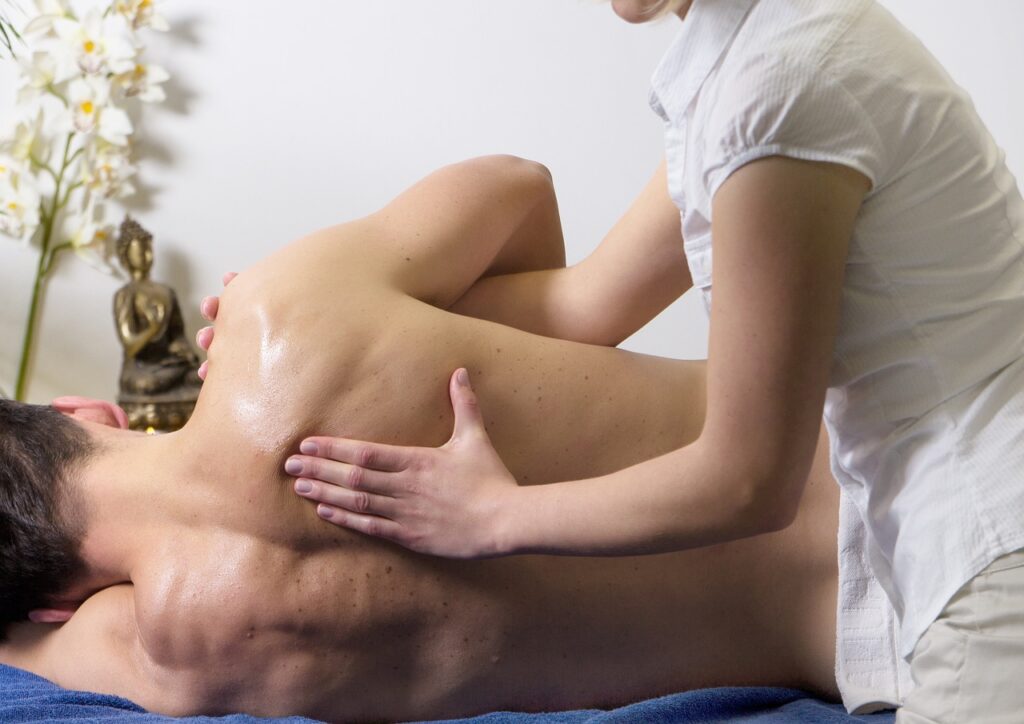
Tabla de contenidos
ToggleMassage is an art as old as mankind. It is a universal language that is spoken of with the hands and that the body understands you perfectly. But, have you ever wondered what exactly happens when a therapist gives you a massage? This is not simply “rub” or “squeezing” at random. There is a choreography precise, a series of fundamental techniques that form the vocabulary of any professional masseuse.
These are the 5 basic movements of a massage: rubbing, friction, kneading, percussion and vibration.
Each one of these movements have a purpose, a depth, and a different effect on your body. Are the musical notes with which a therapist composes a symphony of relaxation and relief. In this article, we will break down each one of these movements. Not only will you explain what they are, but by what they do, how they feel and when they are used.
We want the next time you receive a massage, not only feel, but also to understand the science and the experience behind each touch. We’re going to dive into the fascinating world of the massage maneuvers.
Before the First Maneuver: setting the Stage
Before the first drop of oil touches the skin, the massage has already begun. This preparation phase is crucial and responds to one of the most common questions: “What is the first thing you must do before a massage?”. The response is divided into two parts: preparation of the environment and the preparation of the client.
A professional therapist (Expertise) not only washes her hands. Prepare the room to be a sanctuary:
Temperature: The room should be at a comfortable temperature, as the body tends to cool down when you’re relaxing.
Environment: Soft music, dim lighting and a pleasant aroma (aromatherapy) help the nervous system to “disconnect” from the stress outside.
The couch: Must be comfortable and be prepared with clean sheets.
On your part, as a client, the first thing is to contact. The therapist will perform a small initial interview (anamnesis) to understand your health status, if you have allergies, recent injuries or areas of pain-specific. This is the most important step. Here is where you indicate if you are only looking to relax or if you need to work a contracture. The honesty here ensures a massage safe and effective (Trustworthiness).
Once on the couch, your only job is to take a deep breath and let go.
The 5 Fundamental Movements of Massage: The Alphabet of Touch
Imagine that your masseuse is a sculptor and your muscles are the clay. You need different tools to shape, smooth, smooth and defined. These are the 5 basic movements. Let’s see them one by one.
1. Roce (Effleurage): making Contact
Rubbing, also known by its French term Effleurage (which means to “slip” or “lightly touch”), it is almost always the first and the last movement of a massage.
What is it? It is a smooth glide, fluid, and continuous hands on the skin. Can be done with the palms, knuckles, or the forearms. Can be surface or a little bit deeper, but it is never invasive.
What is your purpose?
Presentation: Is the means by which the therapist “say hello” to your body (Experience). Allows a first evaluation of the muscle tension and skin temperature.
Warm-up: Prepare the tissues for the maneuvers deeper who will come after.
Apply the middle: Is the perfect movement to spread oil or massage cream evenly.
Circulation: Stimulates blood and lymphatic flow in the direction of the heart (motion centripetal).
How does it feel? It feels incredibly relaxing. It is the movement that causes you to drop the first sigh of relief. This brings security and confidence, preparing your mind and body for what is to follow.
2. Kneading (Pétrissage): “Squeezing” the Tension
If the touch was the presentation, the kneading (Pétrissage) is the heart of the conversation. Is the technique that most people associate with the word “massage”.
What is it? It is a movement that involves lifting, compressing, and “wring out” the soft tissues (muscles, skin, and subcutaneous tissue). Think literally how amasarías the dough of a bread. Take the muscle is detached from the bone (if possible), pressed, released, and repeated. Can be done with the palm, fingers, or between the thumb and the rest of the fingers.
What is your purpose?
Descontracturar: operation star to work the muscles tense and overloaded.
Muscle nutrition: The “squeeze” the muscle, facilitates the outflow of venous blood and toxins accumulated (as lactic acid). When it was released, it allows the entry of new blood and oxygen to nourish the tissue.
Flexibility: to Help you “take off” the tissues and enhance the muscle elasticity.
How does it feel? This is the famous “pain that you like”. It can be intense, especially if the area is very contracturada, but must feel a deep and liberating, never sharp or harmful.
3. Friction: The Specific Job and Deep
The friction is the surgical movement of the massage. It is the technique of precision designed to address the problems more rebels.
What is it? Movements are small, localized and deep that are made without sliding on the skin,. The skin moves with the fingers of the therapist (usually the thumbs, fingertips, or even the elbow). They can be circular or transverse (perpendicular to the muscle fiber).
What is your purpose?
Break adhesions: Is the main technique to undo the “knots” (trigger points) and the scar tissue.
Stimulation deep: Comes to the layers of tissue that kneading can’t reach, such as tendons or inserts muscle.
Local hyperthermia: Causes a localized increase in blood flow (the area is red), which speeds up healing.
How does it feel? It is the movement more intense massage. It feels very focused, as if the therapist was “drilling” a specific point. It is essential to have a good communication with your therapist to not exceed the threshold of pain.
4. Percussion (Tapotement): The Awakening Muscle
percussion or Tapotement completely change the rhythm of the massage. We spent of flowing movements and deep to a rhythmic clapping and stimulating.
What is it? It is a series of hits, light, rhythmic and faster on the body. There are several ways:
Hacheteo (Hacking): With the edge of the hand (the side of the pinky finger).
Cacheteo (Cupping): With cupped hands, creating a sound vacuum.
Tap (Tapping): With the tips of the fingers.
What is your purpose?
Stimulation: unlike the other movements, which tend to be sedating, the percussion is invigorating. Wake up the nervous system.
Toning: Help to tone flabby muscles.
Respiratory: The cacheteo in the back is very used in respiratory physiotherapy to help loosen the mucus from the lungs.
How does it feel? Refreshing and energetic. It is usually used in sports massage before a competition or at the end of a session to “wake up” to the client and not go sleepy.
5. Vibration: The Relaxation Neuronal
Finally, we arrived at the movement more subtle, but neurologically very powerful: the vibration.
What is it? It is an oscillatory motion, a tremor fast that the therapist creates with their hands or fingers, and transmits to the customer’s area. It may be a vibration thin and fast, or jolt more broad and slow limb.
What is your purpose?
Calm the nerves: it Has an effect deeply sedative on the nervous terminations. It is excellent to relax muscles that are in spasm or too sensitive to other techniques.
Deep relaxation: Helps to “reset” the muscle tone, inviting you to a relaxation which goes beyond the muscle and reaches the central nervous system.
How does it feel? It feels like a wave subtle that runs through the body. It is deeply relaxing and is often used to finish the job in a particular area before moving on to the next.
Solving your Doubts: frequently Asked Questions about Techniques of Massage
Now that you know the 5 basic maneuvers, it is normal that raises more questions. We’re going to solve the most common that we are in consultation.
What are the 4 massage techniques most commonly used?
This question is sometimes mistaken for “movements” with “types” of massage. If we talk about movements (the maneuvers that we have just seen), the four most used in almost any massage west (such as the Swedish one) are:
Friction (Effleurage): For start, end, and connect.
Kneading (Pétrissage): The main work on the muscle.
Friction: To knots and specific points.
Percussion (Tapotement): To stimulate.
If we talk about techniques, or styles of massage, the 4 most popular globally tend to be:
Swedish Massage: massage classic, which uses mainly the 5 basic movements.
Deep Tissue massage (Deep Tissue): Focuses on muscle layers deeper, using a lot of friction and kneading slow and intense.
Sports massage: Adapted to the needs of the athlete (before, during, or after competing), using percussion, amasamientos quick and stretching.
Thai massage: A different approach that is performed on the floor, with your clothes, and combines pressure with passive stretching like yoga.
What are the 7 principles of massage?
For a massage to be effective, and professional (Authoritativeness), a therapist follows several fundamental principles. Although they can vary slightly, these 7 are universal:
From superficial to deep: you should Never begin a massage with a friction of elbow. Start with the friction surface, it is passed to rub deep, then kneading and, finally, if necessary, friction.
Centripetal direction: The majority of movements (especially of rubbing and kneading) are directed towards the heart. This follows the direction of the venous and lymphatic return, helping the body to eliminate waste more efficiently.
Rhythm and fluency: The massage should have a cadence, a rhythm constant. The hands of the therapist should not lose the contact abruptly, creating a sense of continuity and security.
Globality: Treat the body as a whole. Even if it hurts your neck, a good therapist will also work your back, shoulders, and perhaps even your arms, as everything is connected.
Adaptability: Each body is a world. The therapist must adapt to the pressure, the speed, and the techniques according to the client’s response (feedback, verbal and non-verbal).
Non-maleficence (Primum non nocere): The first principle is to “do no harm”. A massage can be intense, but it should never cause a sharp pain, injury or worsening of a condition.
Active listening: The therapist must be 100% present, listening to what the client says and what your body “tells” (tension, spasms, breathing).
What are the maneuvers of therapeutic massage?
The maneuvers of therapeutic massage are the same 5 basic maneuvers (rubbing, kneading, friction, percussion, vibration), but applied with a clinical objective, and specific.
The difference is not in the tools, but in how they are used. While a relaxing massage, looking for the general well-being, a therapeutic massage focuses on:
Treat a pathology (e.g. low back pain, tendinitis).
Retrieve an injury.
Relieve chronic pain.
For example, in a therapeutic massage will be used much more friction myelitis profound technique (Cyriax) on a tendon that is inflamed, something that would not be in a relaxation massage.
Where do you begin the movements of a massage?
Although each therapist has their own style (Experience), the most common is to start in the back.
Why? The back is the largest area of the body and where it accumulates a large part of the daily stress (both physical and emotional). Start at the back with a rubbing motion long and envelopes allows:
to Induce a general relaxation quickly.
Set the first point of contact and build trust.
To assess the overall tension before moving on to more specific areas such as the neck or legs.
From there, the flow tends to be: back, back of the legs, feet, then the client turns on, and working the legs to the front, arms, hands, and eventually the neck, shoulders and face (if customer want).
What are the 5 types of massage?
There are hundreds of styles, but if we had to choose 5 types of representative and popular, would be:
Swedish Massage: The gold standard for the relaxation. Combine the 5 basic movements to relieve tension general muscle and improve circulation.
Deep Tissue massage (Deep Tissue): For chronic pain, and contractures are very deeply rooted. Intense pressure and slow to get to the deep layers.
Sports massage: Focused on athletes. It can be pre-competition (stimulant), post-competition (retriever) or maintenance.
Manual Lymph drainage: A technique that is very subtle and specific, with movements very smooth and rhythmic, designed to stimulate the lymphatic system and reduce fluid retention and swelling.
Therapeutic massage/Clinical: The mentioned above, focused on treating a specific ailment diagnosed as sciatica or carpal tunnel syndrome.
YOU MAY be INTERESTED to
Talking about therapeutic approaches and the importance of going to the right professional, it is very common for people to confuse the different disciplines that use the hands to heal. If you’ve ever wondered What are the differences between physiotherapy and osteopathy?, we have written a detailed guide where we clarify what each one does and what might be best for you.
The Magic is in the Combination: Beyond the Movements,
Learn the 5 basic movements is like you know the letters. But a professional massage is not to spell “R-O-C-E”. Is writing poetry.
True experience of a massage expert lies in its ability to combine these movements in a smooth fashion. It is a dance where a kneading is melted in a friction that is smoothed out with a brush, and then wake up the area with a light percussion, all of this without your notes where you’re starting from one and ending with the other.
It is not the same as a sports massage, invigorating session of pure relaxing massage in ibiza, where each argument and each vibration seek to bring you to a state of total calm and disconnect. A skilled therapist can read your body and understand that the stress on your neck can have its origin in a strain on the hip or even on the plantar fascia. Therefore, a complete massage that addresses the body as an interconnected system is so deeply effective and repairer.
Conclusion: Your Body Knows what it Needs
Now, you already know the vocabulary secret of your masseuse. The friction that welcomes you, the kneading to release your pent-up tension, the friction that attacks those knots rebels, the percussion that wakes you up and the vibration that calms your nervous system.
A massage is much more than a luxury; it is a powerful tool for the maintenance of your health. It is a deep conversation with your own body, provided by experienced hands that know what to say. The next time you’re in bed, you try to identify these movements. You’ll see how, by understanding the process, your ability to relax and receive the benefits of massage are multiplied